
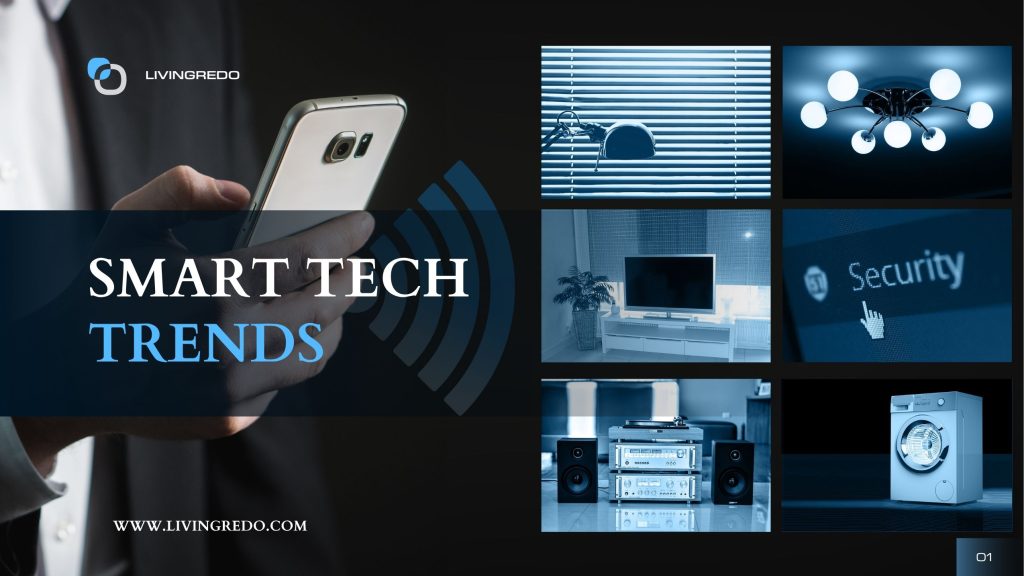
Smart Tech Trends
From convenience to need, technology has changed how we communicate, work, live, and address global issues. Smart technology has become a major driver of this digital transformation in recent years. Not only are these inventions futuristic, but they are also quickly permeating our everyday existence. The world is changing due to smart tech trends, such as voice-activated gadgets and AI-powered medical treatments.
This article highlights 12 powerful smart tech trends that are setting the pace for innovation across various industries.
1. AI Integration Across Industries
Artificial intelligence (AI) is now used in more contexts than only science fiction and research labs. It is actively changing industries like customer service, healthcare, banking, and education. Because AI can interpret medical scans more correctly than humans, it improves diagnosis in the healthcare industry. Predictive analytics helps businesses make better decisions. AI simplifies supply chains and personalises consumer experiences in retail.
AI’s ability to analyse data in real time is also essential for automating difficult jobs, reducing operating expenses, and increasing productivity.
2. The Evolution of Smart Wearables
Wearable tech has gone far beyond counting steps. Devices like fitness trackers, smartwatches, and even smart rings now monitor heart rates, sleep quality, blood oxygen levels, and stress patterns. For athletes and health enthusiasts, wearables provide real-time feedback that encourages smarter lifestyle choices.
Enterprise sectors are also embracing wearable technology to increase efficiency and safety, especially in emergency response, construction, and logistics.
3. Voice-Activated Ecosystems at Home and Work
Speech-activated ecosystems are becoming smooth thanks to smart speakers and speech assistants like Apple’s Siri, Google Assistant, and Amazon’s Alexa. Simple commands can control lights, thermostats, music, and even grocery shopping.
In offices, voice tech helps with scheduling, setting reminders, and managing workflows. This hands-free interaction enhances efficiency and accessibility for people with disabilities.
4. Next-Gen Smart Cities and Infrastructure
Smart city infrastructure is being invested in by governments and urban planners to improve sustainability, efficiency, and quality of life. These projects include public Wi-Fi networks, smart lighting, and intelligent traffic systems. Sensors monitor air quality and energy consumption, while predictive maintenance prevents service disruptions.
Smart cities also enable real-time communication between residents and municipalities, improving transparency and responsiveness.
5. Smart Tech Trends Reshaping Consumer Lifestyle
One of the most fascinating smart tech trends is its direct impact on consumer lifestyle. Smart refrigerators suggest recipes based on their contents. Robotic vacuum cleaners operate on schedules. Smart TVs adjust volume based on ambient sound.
These lifestyle integrations offer more than convenience—they represent a shift in how consumers interact with their environments. The trend points toward a fully connected life in which appliances adapt proactively to user needs.
6. IoT and Hyperconnected Devices
Internet of Things (IoT) connects billions of devices—home appliances, vehicles, industrial machines, and wearables—allowing them to collect and share data. This connectivity boosts efficiency, safety, and convenience.
In agriculture, IoT sensors monitor soil conditions and weather to optimise crop yield. In logistics, smart tags track product movement in real-time. IoT is also crucial in manufacturing for predictive maintenance and quality control.
7. Augmented Reality (AR) in Everyday Applications
AR is enhancing everything from gaming to online shopping. Apps like IKEA Place let users see how furniture would look in their homes. Makeup brands offer virtual try-ons, and navigation apps overlay directions on the real world.
Beyond consumer use, AR is transforming education by making learning more interactive and assisting remote workers and field technicians with real-time visuals and instructions.
8. Automation in Transportation and Mobility
Autonomous vehicles, drones, and self-navigating delivery robots are no longer experimental—they’re being tested and rolled out worldwide. Ride-sharing companies like Uber are investing in self-driving fleets. Logistics firms are using drones for last-mile delivery.
These innovations promise reduced human error, better fuel efficiency, and improved mobility for elderly and disabled individuals. Smart mobility solutions are also crucial for traffic decongestion and reducing carbon footprints.
9. Sustainability Through Smart Energy Systems
In both home and commercial settings, smart energy solutions are promoting sustainability. Nest and Ecobee are examples of smart thermostats that use user behaviour to modify heating and cooling in order to minimise waste. Smart grids that store excess energy for later use are now connected to solar panels.
Smart meters give real-time insights into electricity consumption, helping users and providers manage usage more efficiently. The broader goal is a sustainable energy ecosystem that’s both cost-effective and environmentally friendly.
10. Edge Computing and Real-Time Data Processing
Traditional cloud computing can be slow when instant responses are needed. Edge computing solves this by processing data closer to the source—on the “edge” of the network. This is especially important in sectors like autonomous vehicles, healthcare, and manufacturing, where real-time decisions are critical.
By reducing latency, edge computing enables faster responses, reduces bandwidth usage, and supports high-performance applications.
11. Blockchain in Smart Tech Environments
Originally designed for cryptocurrencies, blockchain is now disrupting other areas by enabling secure, transparent, and decentralised transactions. In smart tech environments, it secures IoT communications, ensures data integrity, and supports supply chain transparency.
Blockchain also enables digital identities, smart contracts, and decentralised finance—all vital components of next-generation tech ecosystems.
12. Robotics and Human Collaboration
Robots are transitioning from solitary production lines to settings where they collaborate with people. Often referred to as “cobots” (collaborative robots), they help with dangerous or repetitive activities, increasing efficiency and safety.
From hospitality to agriculture, these robots enhance operations while allowing human workers to focus on creative or strategic roles. Their precision and reliability are transforming what’s possible across industries.
FAQs
Final Thoughts: What the Future Holds
The future of smart tech trends is dynamic, fast-paced, and incredibly promising. These 12 powerful innovations show that we’re entering a new era—one where smart devices and systems aren’t just tools, but partners in everyday life and industry.
Innovation will continue to enhance our way of living, working, and interacting; examples include artificial intelligence (AI), Internet of Things technologies, and sustainable energy systems. Keeping up with these ingenious technical advancements is not only beneficial but also essential for anyone seeking to thrive in the digital age.